Life as a Cog
by Mike Jaynes / August 30th, 2008
The disturbing feeling of Cog-ness is slowly creeping into our nation’s educated citizens. By educated, I do not mean those of us with various alphabet soups behind our gentrified names, but those who have begun to realize this American Dream isn’t what we signed up for. And by Cog-ness, I mean the Machine. Much has been written on our quaint and overly mechanized materialistic system and its class slavery, but there is even more ground to cover. The wheel of the world keeps spinning around its eight-to-six slave driving and passionless axis while the outer rim of the super wealthy continues to be supported by the spokes of hard working American types who never take a day off unless they have to and believe in words like Freedom and Justice while possessing neither. And the wheel of America, in its ever accelerating downward roll, continues to squash any country and every culture that happens to wander into its path. For confirmation, examine the tread marks on flattened Iraq, Sudan, and the like. Or google “factory farming” and look at our wonderful factory farmed meat industry. Real warm and fluffy. Hopeful, you know.
We’ve been told that if we work hard, stay honest, do our best, and floss every day we will have good lives. We’ve been told not to complain, believe in God, and keep our heads down; keep a low profile. We’ve heard this our whole lives. The problem, and what inspires considerable stress related gastrointestinal cramps in The Man, is that the inherited sociocultural beliefs of past generations won’t do anymore. They are no longer relevant. Across the country, people are beginning to pay attention and complain with the best of them. But stay in line, we are told. Corporations weed out possible rebels and free spirits with standardized personality and drug testing and the university realm of academia scoffs at any would be teachers lacking multiple graduate degrees on their resumes. As if jumping through various systematic hoops of academic accomplishment proves one dynamic enough, creative enough, and worthy to educate the up and coming troublemakers of tomorrow. The low wage workers, as researchers such as Barbara Ehrenreich tell us, are told to value hard work and not complain and continue to pull the hard unforgiving yoke on the ground floor of the machinery.
And then there is God. Or rather, the popular Americanized version. The drifting vagrant Christ who said Love each other and Do the Right Thing before adorning some knotty pine seems not to be present. America holds God up as a threat to these low wage worker slaves showing them: See? Jesus had it way worse than you, and he didn’t complain. And often the low wage view is skewed as well. Here in East Tennessee, on UT football nights, God is undoubtedly inundated with countless southern inflected twangy voices begging for the Vols to make those two last yards for the first down. This is distressing, and it seems best if we just left the whole subject out of the quest for personal freedom. Often my students are confused, and we examine beliefs on God much like Serge A. Storms’ in Triggerfish Twist: “I’m not saying God doesn’t exist. I believe in God. But he’s not a micromanager, so stop asking Him to drop the crisis in Rwanda and help you find your wallet.”
However, in my experience as a university lecturer in English and the Humanities and an animal advocate, plenty of students are catching on. They are getting the vague and uneasy feeling that overly reductionist religious systems and outdated social codes are selling a comfy cell block box with all the trimmings in which to live, in which to stay in line. Our jailers are masters of deception, and they use chains with such subtle disguising craftsmanship Hephaestus himself would be proud of them. In our comfy ornate boxes, the jailers give us pretty shackles to wear. Not only do we wear them, but we must go out and purchase them and pay for them with our hard earned money (nah, just charge it). Akin to docking a prisoner for his meals, we pull on the woolly snug chains of comfort in complete ignorance. Ipods, absurdly large and flat television screens on which we watch absurdly large and fake heroes. More clothes than anyone could wear, Hummers, overly aggressive predatory student loans, and more. Oh yes, don’t forget the wholesale slaughter of countless animals who think, live, and acutely feel pain. Sure, I realize many feel these purchases are their right. They earned the money or have the credit, so who am I to say these excesses are wrong? Who says we can’t eat animals? I do. The minute you find yourself plopping down huge percentages of your monthly income for unneeded things, you are wrong. I’ve been there as well, so save your righteous indignation. If you have not examined the reasons behind your desire for things, you need to rethink, or perhaps simply think. And that is why my writing and classes often inspire controversy…I feel no reason to subscribe to a hypocritical system of political correctness in which I do not believe. So I feel I am someone who is right and not hesitant to admit it. It is not ego; it is simply truth.
Ah yes, it is a part of my dilettante palm-tree-methodology and life path to live and let live, so don’t expect me to come fire bomb any Hummer dealerships. Been there, done that, so to speak. If you want to eat the cooked flesh of a tortured animal, that is your choice; it is our choice to live as we chose. That, in fact, is one of the only true values America has to offer us. Therefore, hateful small minded responses do not anger me. Rather, I am quite entertained by them because there always is the possibility that my paradigm could be flawed in some way unbeknown to me. You know, I could be wrong. But, materialism, class division, animal slavery, overly reductionist religious institutions, and ignorance are the problems in this society as I see them and unlike so many millions who have came and gone before me quite unnoticed, I don’t have a big interest in faking sincerity and keeping my head down.
Predatory credit card companies, criminal mortgage lenders, slaughterhouses and factory farms, absurd student loan companies, and well spoken politicians who truly do not care about the plight of commoners are all too vocal and powerful and committed to exploiting the lower classes for outrageous financial gain. So why should people who realize the version of Freedom we have been sold has come at the cost of soulless conformity remain politically correct and silent? Why should the cogs keep evenly greased and silently turning? The squeaks of social unrest, class consciousness, and animal/civil rights are quickly greased by cheap government bureaucrats with six part plans efficiently going nowhere. The truth is the poor are simply minor speed bumps on the road to upper class elitism, a minor annoyance with no real teeth, nothing to damage the SUVs of the Very Well Adjusted and Upwardly Mobile. So go ahead, crush them as you ladder climb because it’s completely your right to do so. Go ahead and destroy them and their hopes, you won’t hardly even think about it; it won’t trouble you at all.
Being a system in which one can rise above one’s situation, achieve a higher level of socioeconomic successs, and then haughtily look down on members of one’s previous socioeconomic class, America may not be as Great as they once told us. The present wealth oriented America system depends on the ignorance and placidity of us cogs to stay silent and take what they can give us. Then, after an adult lifetime of crushing labor, we can get a company watch and know that we never started any trouble and kept to ourselves. Perhaps the tombstones of the current American low wage workforce could have a single inscription above a collective mass grave: Good American. Worked Hard. Never Caused Trouble. Socially Accepted. Historically Irrelevant. Not that their one track activism is always the correct approach, but as those mysterious maskers at A.L.F. and E.L.F. would no doubt tell us, there is talking and there is doing. Until the majority of Americans realize our superimposed socioeconomic slavery and decide to raise complete and holy hell, this article — and all others like it — is the worthless talk of self-important academics. Thanks for reading. I’ll be around.
Saturday, October 25, 2008
Life as a Cog


Wednesday, April 9, 2008
religionexplained.jpg (JPEG Image, 578x554 pixels)
I stumbled to the following image:
religionexplained.jpg (JPEG Image, 578x554 pixels)
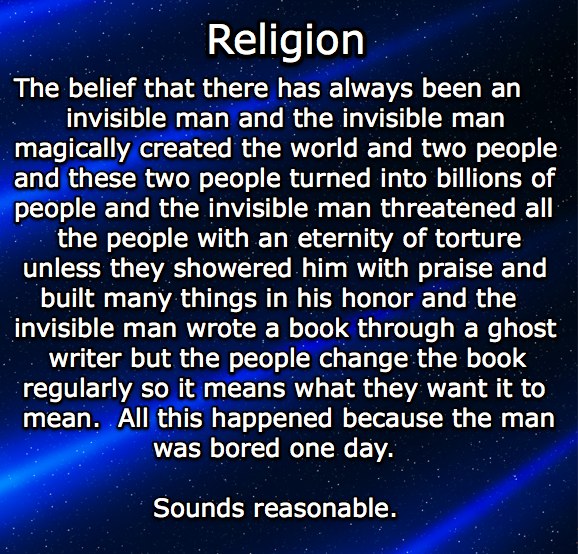
Sometimes atheists are accused of being shrill, arrogant, blasphemous and rude when we criticize religion in terms like depicted above. That doesn't mean we're wrong, but it may turn some away from our message. However, I think it wins far more arguments and converts than it loses.
Hyperbole can be a useful tool in debates, especially when categorizing your opponent's arguments. Hyperbole has a way of simplifying the debate instantly. Once we refuse to respect conventions about blasphemy, "God" becomes a god, and then a target of ridicule.
But, it's more than that. Extreme characterization of the Christian beliefs like the one above can force Christians to examine their beliefs more closely. The reader who is shocked by the mockery implicit in the "imaginary man" reference to their god is forced to ask themselves, "in what way is that characterization wrong?" "In what ways do my beliefs differ from this idea of a capricious, malicious god?" The cumulative effect of these internal questions, even if subconsciously, can have a powerful effect, I believe. Even forcing them to ask themselves why atheists would believe this way about "God" can cause them to put themselves into our shoes and manufacture reasons for our disbelief.
This will never produce instantaneous results (other than offending the unsuspecting Christian), but I believe that it will have an effect. And always remember, "blasphemy is a victimless crime".

Thursday, March 20, 2008
Psychological problems and religion: the de-conversion process
See, this is what I've been saying. Religion is a cult. It's just a very popular cult, and your family may be part of the cult, and you may be the only person you know that the cult hasn't brainwashed. Valerie Tarico writes on the Huffington Post:
Most religions implant psychological safeguards against apostasy, little emotional bombs of fear, guilt, shame and self-loathing that get triggered by the mere act of questioning. In religious orthodoxy, doubt is the domain of fools. It is the consequence of having hardened your heart like Pharaoh or resenting God's power like Lucifer. Oh ye of little faith!
I know that fear of their reaction is at least a part of my reluctance to identify myself as an atheist to my family. Accountant by Day had a post recently about this very issue, and it turns out that the initial aftermath wasn't as bad as she expected. Anyway, the only way to find out what the fallout will be is to go forward with it. It's the brave thing to do, but it's one of those things where the timing never really seems right. I'm sure that's my psychological reluctance to do so subtly expressing itself, but it doesn't make it any easier.
True.Even among my professional peers, psychologists, far too few understand the depth of harm that can be done to the psyche by fundamentalist religion -- religion that subsumes the individual self to a cult self. The irony is that few mental health professionals are sympathetic to the claims of moral dogma. The practicing therapist is exposed daily to life's caprice: biochemical malfunctions, developmental vagaries, and rotten life circumstances. In contrast to a religious perspective, psychology seeks to understand material and historical roots of symptoms rather than making moral judgments. So the problem is not that the professional world view aligns with a dogmatic world view. It is just that, in the absence of dramatic evidence to the contrary, we are all taught to think of religion as harmless.
It's time to give up the illusion.
Monday, March 17, 2008
An Atheist in the Pulpit
Psychology Today has a very interesting article about the de-conversion process, especially among various clergy members they profile. Although it was more about the clergy and their struggles once they begin to doubt religion, I recognized a lot of myself in their comments as well. You can read the full article here: Psychology Today: An Atheist in the Pulpit
As I wrote about here, I was once a pretty fundamentalist Mormon. Frankly, I'm not sure that there are any other kind of Mormon, which is why it's a wonderful thing Mitt Romney is not in the race any more. My de-conversion process was similar to that of many others: I got a taste of the "outside" world, and the cognitive walls that religion forced me to construct came tumbling down. From the Psychology Today article:
"We tend to ignore how much cognitive effort is required to maintain extreme religious beliefs, which have no supporting evidence whatsoever," says the evolutionary biologist David Sloan Wilson. He likens the process to a cell trying to maintain its osmotic pressure. "You're trying to pump out the mainstream influences all the time. You're trying to maintain this wall, and keep your beliefs inside, and all these other beliefs outside. That's hard work." In some ways, then, at least for fundamentalists, "growing out of it is the easiest thing in the world."This is why religion is forced to remain so dogmatic-- once they begin to admit that small pieces of their proposed worldview no longer make sense given what we now know about man's place in the universe, the whole structure comes down. That's certainly the way it was for me, once the leaks sprung in the levees, it was too late to save them. Not that I would have it any other way. I felt the same kind of liberation experienced by Dan Barker of the Freedom From Religion Foundation as profiled in the article:
The confirmation, as Barker interpreted it, came one night in November, as he lay on a burlap cot in a church in a Mexican border town where he'd come to give a guest sermon. As he peered out at a splash of stars, Barker had a sudden profound sensation that had nothing to do with intellect, the kind of deeply felt moment more commonly associated with finding God than losing Him. He was, Barker understood, utterly alone here.
"For my whole life there had been this giant eyeball looking at me, this god, this holy spirit, this church history, and this Bible. And not only everything I did but everything I thought was being judged: Was God pleased? I realized that that wasn't there anymore. It occurred to me, 'I own these thoughts. Nobody knows what I'm thinking right now. There's no fear of hell, no fear of judgment, I don't have to be right or wrong, I can just be me.'" It felt as if charges had been dropped for a crime for which he had been falsely accused. It was exhilarating and frightening all at once. "When you're ready to jump out of an airplane to skydive, you can be terrified but excited at the same time," he says. "There's a point where you go, all right, let's do this."
Those thoughts almost brought tears to my eyes, so close were they to what I went through: "I own these thoughts. Nobody knows what I'm thinking right now....I don't have to be right or wrong (or good or evil based on outdated mores), I can just be me." After a lifetime of being told that there was this Big Brother entity that had access to all my secret thoughts, dreams, and desires, to realize that I was in control of my life was like a breath of air to someone who had been slowly suffocating.
There was not much room for nihilism in my new world view. I passed briefly through the nihilism stage, to emerge on the other side emboldened and exhilarated. Life now had so much to offer, that was previously closed off to me. Like Richard from De-Conversion had experienced:
I myself found that my own meanings eventually expanded, after I finally left the Christian faith. “Saying yes to life” for me meant, initially, the exploration of life, making up for lost time so to speak, from all those years spent as a neurotic fundamentalist. I wanted to taste life in all its forms and in all its experiences — to “suck the marrow from life”, as Thoreau had put it. I developed friendships with non-Christians, I traveled, I explored new foods, I learned about wine (I had never drunk much as a Christian), I started dating (I had never dated much as a Christian, either), I explored ideas I had never allowed myself to consider (like Nietzsche’s!), I learned about other religions, and more. Just going out dancing was one of the highlights of that time of my life.
In short, the main theme, for me, for these many years of my life, was: the world is good, and beautiful, and that is why life is worth living.
And that's where I find myself now. I love the intellectual freedom that I have, and I love the freedom to just enjoy spiritual experiences without trying to read some other kind of meaning into them. I don't have to worry if god is trying to get my attention with some subtle message or "still small voice".But my dad does. The thought of coming out as an atheist has been on my mind a lot recently. I didn't feel as though it was the right time a week or so ago as my wife and I had dinner with my dad. He had just returned from a brief trip to Utah to spend some time with his father (my grandfather) before he passed away, then attend his funeral. One of the primary reasons for religion to exist is that it provides some kind of comforting answer for the question "What happens when we die." I think my dad needs that comfort right now, and no matter how much it grates on me to hear his religious gyrations, I held my tongue and just tried to let him get out the feelings.
All of this is part of why I feel sometimes like an atheist evangelist. We are the ones that really have the good news: you are free to live your life without fear of eternal damnation. You can be a good person because you truly are a good person, not out of fear or seeking for an eternal reward. The world is a beautiful place, made more precious because we realize that every day is a gift; we have but one life to live. The same sense of freedom and exhilaration is available to everyone, if only they will open their eyes.
Friday, February 8, 2008
Mormons Dismayed by Harsh Spotlight - WSJ.com
Mormons Dismayed by Harsh Spotlight - WSJ.com
This whole presidential campaign has been especially interesting to me, as a former (recovering?) Mormon. To see the way Mormons are portrayed in the media, to read the commentary from other religious and secular sources, and to consider my own thoughts and feelings has been a unique experience for me.
As a child and adolescent, I remember being taught in church the standard "party line" for questions like "are Mormons Christian?", "does your dad have lots of wives", etc.... At the time, I thought that the way we were perceived by mainstream Christians was silly-- after all, shouldn't we as Mormons have the right to self-identify as Christians? Doesn't professing belief in the divinity of Christ count? If the church outlawed polygamy a hundred years ago, why are we still getting this question? We were taught, both implicitly and explicitly, that the reason for these questions was essentially jealousy or other latent ill will because we were the "one true religion". All of these false churches were banding together against us because we had the revealed truth! It was so obvious!
Once in college, I devoured philosophy courses. I realized that the doubts that I had were not unique to me, that there was nothing wrong with pursuing metaphysical questions. When you're a Mormon, questioning is mildly discouraged. Questioning too much might lead you to false prophets, away from the truth. That mindset never really sat quite right with me, but I was always told to pray about it, listen for a "still, small voice" that would tell me God's will. Mormons place a great deal of emphasis on the concept that prophecy is not dead, that God personally, literally, speaks. Only, I never heard anything. I assumed that I was unworthy, that the very existence of my doubts had blocked me from being receptive to the voice of God. It wasn't until I started reading more of the philosophy of religion that I realized it was both normal and healthy to question the existence of god. Atheism was a viable alternative. Not only viable, it was the only option that made sense to me. The thing that I loved about philosophy was that nobody was telling me the answers. There were no "answers". There was a process of thought. Nobody was promoting atheism, or theism, or one religion over another; there was only an insistence that you had to have good reasons for whatever you believed. Your beliefs had to have intellectual consistency.
For me, there was no turning back. I tasted freedom, and reason was my new standard. It still is.
It wasn't until this year that I started thinking again about the issues that Mormonism raises, due primarily to Mitt Romney's campaign. Only now, I got to see the commentary from the outside, as a non-Mormon. What a difference! Then I read the front page article- above the fold no less- from today's Wall Street Journal. What a perfect catalyst for this post, which I had been considering writing for some time. Most Christians today seem to have a bit of a persecution complex (see also Bill Donohue), but Mormons have it worse than most. They've still got it in the back of their mind that the founder of their church was martyred and they were forced to flee to Utah in search of religious freedom (read: polygamy). Add to this the conviction that they are the "peculiar people" and that Satan is actively trying to keep people from their religion because of its truth, and one develops quite a heady mix of persecution complex.
In spite of this, there was always the sentiment within the church that they were making headway. The church was growing rapidly, both home and abroad, which only fed the conviction that people were finding the truth irresistable. That's the context behind the article in the Wall Street Journal- that's why Mormons are so surprised now to find that people still don't like them. *gasp* Mormon beliefs are still mistrusted within and without Christianity, and rightly so.
Mr. Romney's candidacy revived old lines of attack and mockery of some of the church's unusual practices, such as secret ceremonies, the wearing of special undergarments, and the baptizing the dead in the belief that it will help them join family members in heaven.
The only thing that I don't understand is why Mormon beliefs are ridiculed within Christianity, but Christian beliefs are not held up to the same level of ridicule in society at large.
I apologize, but I can't remember the radio show I was listening to, but the host had a brilliant bit of satire. It was several weeks ago, and he was trying to argue that the religion of a candidate ought not be a part of the equation for determining who you are going to vote for. He was deadpanning that "yes, those Mormons are so ridiculous for believing that an angel came to Earth with golden plates, revealing a new religion. All good Christians know that it really happened when a new star appeared in the sky and a virgin gave birth to the literal son of god. All good Christians know that they literally are eating the flesh and drinking the blood of this god-man when they take communion. They know that the universe was created in six days, and two of every animal in the world rode on a boat at the same time. And of course, all good Muslims know about the 72 virgins awaiting martyrs..." Again, I can't remember the exact source, but if someone remembers, please post it in the comments.
None of these beliefs make any damn sense given what a rational person can observe about the world around them. This is what I came to realize about all religions. The more I thought about them, the less sense they made. Once I stopped accepting the dogma I was fed, the scales fell from my eyes and I was able to think. This is why I make fun of you if you believe in unbelievable things. This is why I occasionally toy with the thought of moving to northern Europe, where things are a little more sane. This is why I'm outraged when you say you want to put prayer back in the schools, or change the constitution, or limit stem cell research, or any of thousands of things that you do that hurt other people or take away their rights without any good reason. This is why I'm an atheist.
Planet Atheism


 Posts
Posts


