Showing posts with label brights. Show all posts

Thursday, December 11, 2008

George Bush bible comment shocked evangelicals

I've been debating with myself for quite some time this question: Is George Bush the dumbest person ever to have lived, or simply one of the worst people ever to have lived?

Bush Bible comment shocked evangelicals

Bush made the controversial statement during a Monday interview on ABC's Nightline. When asked whether he thinks the Bible is literally true, he replied, "Probably not. No, I'm not a literalist, but I think you can learn a lot from it."

...
Bush further stated in the interview, "I think that God created the Earth ... and I don't think it's incompatible with the scientific proof that there is evolution."
So, he's got that going for him. Since he's not so stupid as to believe the bible is literally true, or that evolution is "just a theory", then that makes him smarter than most fundamentalist Christians. However, that pushes him closer towards the "worst person ever to have lived" category.

Wednesday, November 19, 2008

A very special welcome to the newest Warrior in the "War On Christmas"


I love the smell of hypocrisy in the morning!! Uber- dumbass Bill O'Reilly has been rallying the troops to defend Christmas in the imaginary "War on Christmas" for years. In fact, he's already begun this year's lobbying for Christmas. Annually, he encourages boycots of stores that say "happy holidays" or some variant thereof instead of "Merry Christmas". Now isn't it delicious when he screws up and lists his "holiday" reading list.

h/t: Think Progress

Wednesday, November 12, 2008

10 commandments vs. 7 Aphorisms- PART II

Sometimes I'm so brilliant, it scares me. Here's what I said this morning on the case:

The city is arguing that once they accepted the first monument, the city adopted it as part of it's own free speech, and therefore are under no obligation to accept competing messages. As far as I can tell though, you can't have it both ways. Either this is free speech or it's not; either it's an unconstitutional establishment of a state religion or it's a public park open to other messages. The city's kind of in an impossible situation here- they have to argue that the 10 commandments display is not an establishment of state religion while also denying competing religions the right to a similar public forum.
Here's the big issues in court today:
Though not directly at issue in the case, the establishment clause question lurked close to the surface in today's argument. Roberts said a declaration that the Pleasant Grove monument was government speech would make it harder for the city to argue that it wasn't favoring one religion over another.

``You're really just picking your poison, aren't you?'' he asked the town's lawyer, Jay Sekulow.

Justice David Souter said a high court ruling forcing the city to adopt the Ten Commandments message as its own would be fatal to the town's defense under the establishment clause.

``Isn't that what is driving this?'' he asked Summum's lawyer, Pamela Harris.

Harris said the city was trying to avoid having to formally subscribe to the particular version of the Ten Commandments on the park monument. She said the town ``wants to have it both ways.''

Monday, November 3, 2008

Atheists should get out of the country?


I often wonder if people think about the things that they say. Even in an environment like a local "letters to the editor" column in a newspaper, sloppy thinking abounds. I've seen this before, but it showed up on Digg again today, and I got curious where "Soldotna" is. Turns out, it's less than 200 miles from Wasilla, land of Sarah Palin. I don't mean to impugn all of Alaska with these two examples of morons, but it certainly does make me wonder...

Wednesday, April 9, 2008

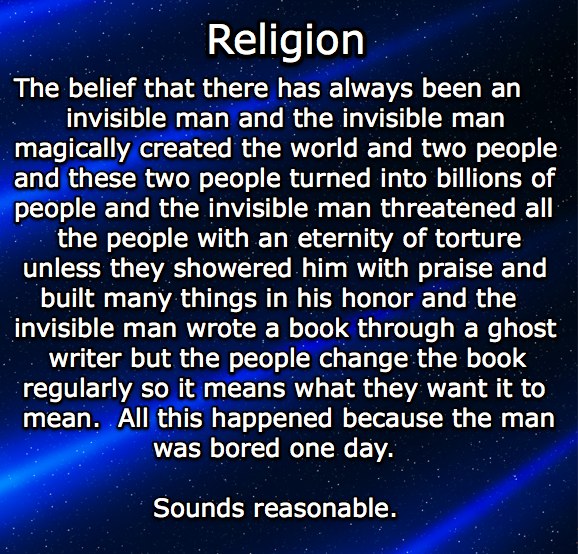
religionexplained.jpg (JPEG Image, 578x554 pixels)

I stumbled to the following image:
religionexplained.jpg (JPEG Image, 578x554 pixels)

http://www.the-atheist.com/wp-content/uploads/2007/10/religionexplained.jpg


Sometimes atheists are accused of being shrill, arrogant, blasphemous and rude when we criticize religion in terms like depicted above. That doesn't mean we're wrong, but it may turn some away from our message. However, I think it wins far more arguments and converts than it loses.

Hyperbole can be a useful tool in debates, especially when categorizing your opponent's arguments. Hyperbole has a way of simplifying the debate instantly. Once we refuse to respect conventions about blasphemy, "God" becomes a god, and then a target of ridicule.

But, it's more than that. Extreme characterization of the Christian beliefs like the one above can force Christians to examine their beliefs more closely. The reader who is shocked by the mockery implicit in the "imaginary man" reference to their god is forced to ask themselves, "in what way is that characterization wrong?" "In what ways do my beliefs differ from this idea of a capricious, malicious god?" The cumulative effect of these internal questions, even if subconsciously, can have a powerful effect, I believe. Even forcing them to ask themselves why atheists would believe this way about "God" can cause them to put themselves into our shoes and manufacture reasons for our disbelief.

This will never produce instantaneous results (other than offending the unsuspecting Christian), but I believe that it will have an effect. And always remember, "blasphemy is a victimless crime".

Tuesday, April 1, 2008

Thumbs up for hands-only CPR :: CHICAGO SUN-TIMES :: Health News

Thumbs up for hands-only CPR :: CHICAGO SUN-TIMES :: Health News

In a major change aimed at getting more bystanders to do CPR, the American Heart Association now says it's OK to skip the mouth-to-mouth resuscitation when performing CPR on adults having a heart attack.

New guidelines issued by the organization Monday encourage non-medical professionals to use hands-only CPR -- doing hard, fast chest compressions -- instead of a combination of chest thrusts and rescue breathing, as long recommended.

By making CPR less complicated, the aim is to get more people to try doing it in an emergency.

"Many times, people nearby don't help because they're afraid that they will hurt the victim and aren't confident in what they're doing," said Dr. Michael Sayre, lead author of the new recommendation. "We want people to know that they can help many victims just by calling 911 and doing chest compressions. Don't be afraid to try it."

The shift is supported by evidence from three large studies done last year that found survival rates weren't hurt when mouth-to-mouth wasn't used, the heart association said.

However, important to note, prayer remains a non-viable alternative. If someone around you is choking, please DO NOT pray for them, please DO SOMETHING instead.

Monday, March 31, 2008

Murder vs. faith-healing (or doing nothing)


The FFRF has a new press release with their perspective of the death of Madeline Kara Neumann from diabetic ketoacidosis while her parents did nothing while praying for her. I fully agree with their strongly-worded press release, and the authors seem to be putting up with the same sort of fractal wrongness that I talked about last week. These parents, their supporters, and frankly the Wisconsin Legislature, are wrong at such a fundamental level that they can't even understand why brights are so saddened and enraged by this.

What's even more appalling is the ambivalent reaction: "Ethicists say case unclear," reports the Wausau Daily Herald. The Herald quoted bioethicist Dr. Norman Fost of the University of Wisconsin Medical school warning that it's important not to be moralistic or pass judgment on parents who think they can heal a child through prayer: "They believe they're helping their child; they love their child, and they believe prayer has an effect."

However deluded the parents may be, the rest of us need not countenance or indulge that dangerous delusion.

Dean Zuleger, the administrator of the Village of Weston, was quoted by the Milwaukee Journal Sentinel saying, "There is a general sense of grief and sadness. Because I know the family a bit, there is a great deal of concern for their well-being." The parents' well-being?

"Death draws out difficult issues" read a headline in the Journal Sentinel. While Madeline's drawn-out death, involving nausea, vomiting, excessive thirst, weight loss and weakness, is very difficult to read about, there is nothing difficult at all about deciding where the blame lies. "The prayer of faith will heal the sick," according to James 5:15. The fault lies in society's laudatory attitude toward a "holy book" which teaches superstition and faith-healing, whose passages are latched onto by bible literalists, and whose obedience to such injunctions has been given a pass in the criminal statutes of many states.


Hattip to Friendly Atheist for the update

Wednesday, March 26, 2008

'Police: Girl Dies After Parents Pray for Healing Instead of Seeking Medical Help'

Monday, March 24, 2008

Certifying Parents - WSJ.com

Certifying Parents - WSJ.com

Apparently Nebraska isn't the only state grappling with what sorts of regulation is needed for homeschooling. The Wall Street Journal published an opinion piece last week responding to a California judge's ruling that requires a teaching credential to teach children, even if they are your own and even if they are homeschooled.

This case is different from the Nebraska one in that Nebraska's issue was raised by the legislature, not the judiciary. Not that it makes a difference to the legions of homeschoolers who have been gnashing their teeth over this infringement of their rights. Or at least if you listen to all the hyperbole. For some reason, any attempt to regulate or quantify results of homeschooled kids is met with large-scale opposition.

As I've mentioned before, I don't believe that there's a "bright-line" between who's right and wrong on these issues. Of course parents should have the right to raise their children as they see fit, barring any sort of abuse. I'm just not sure what ought to count as abuse. Is it young-earth creationism? In any case, this issue is a useful one to tease out whatever particular biases your news source has. For example, the Wall Street Journal opines:

That so many families turn to home schooling is a market solution to a market failure -- namely the dismal performance of the local education monopoly. According to the Home School Legal Defense Association, the majority of states have low to moderate levels of regulation for home schools, an environment that has allowed the option to flourish, especially in the South and Western U.S. Between 1999 and 2003, the rate of home-schooling increased by 29%.

For some parents, the motive for home schooling is religious; others want to protect their kids from gangs and drugs. But the most-cited reason is to ensure a good education. Home-schooled students are routinely high performers on standardized academic tests, beating their public school peers on average by as much as 30 percentile points, regardless of subject. They perform well on tests like the SAT -- and colleges actively recruit them both for their high scores and the diversity they bring to campus.

In 1994, a federal attempt to require certification of parent-teachers went down in flames as hundreds of thousands of calls lit up phone banks on Capitol Hill. The movement has since only grown larger and better organized, now conservatively estimated at well over a million nationwide. But what they can't accomplish legislatively, unions are now trying to achieve by diktat from the courts.

So, to them, homeschooling is both an issue of free markets and inappropriate judicial activism. The homepage for the "Homeschool Legal Defense Association" showcases this perspective:


So clearly to them, it's both a religious and a constitutional issue. Although in the rhetoric about various homeschooling issues, the HSLDA invariable asserts that homeschooling is a "fundamental" right, apparently their website argues that it is a right that requires constitutional protection. I'm terrified what constitutional changes they are seeking, especially if Dr. Dobson is on board. Here's the text of the proposed constitutional amendment:
DRAFT PARENTAL RIGHTS AMENDMENT
FOR THE UNITED STATES CONSTITUTION

SECTION 1
The liberty of parents to direct the upbringing and education of their children is a fundamental right.

SECTION 2
Neither the United States nor any state shall infringe upon this right without demonstrating that its governmental interest as applied to the person is of the highest order and not otherwise served.

SECTION 3
No treaty nor any source of international law may be employed to supersede, modify, interpret, or apply to the rights guaranteed by this article.


What do you think? It appears to be ambiguous, over-reaching, and completely unneccessary to me.

Thursday, March 20, 2008

Psychological problems and religion: the de-conversion process

See, this is what I've been saying. Religion is a cult. It's just a very popular cult, and your family may be part of the cult, and you may be the only person you know that the cult hasn't brainwashed. Valerie Tarico writes on the Huffington Post:

Most religions implant psychological safeguards against apostasy, little emotional bombs of fear, guilt, shame and self-loathing that get triggered by the mere act of questioning. In religious orthodoxy, doubt is the domain of fools. It is the consequence of having hardened your heart like Pharaoh or resenting God's power like Lucifer. Oh ye of little faith!

I know that fear of their reaction is at least a part of my reluctance to identify myself as an atheist to my family. Accountant by Day had a post recently about this very issue, and it turns out that the initial aftermath wasn't as bad as she expected. Anyway, the only way to find out what the fallout will be is to go forward with it. It's the brave thing to do, but it's one of those things where the timing never really seems right. I'm sure that's my psychological reluctance to do so subtly expressing itself, but it doesn't make it any easier.

Even among my professional peers, psychologists, far too few understand the depth of harm that can be done to the psyche by fundamentalist religion -- religion that subsumes the individual self to a cult self. The irony is that few mental health professionals are sympathetic to the claims of moral dogma. The practicing therapist is exposed daily to life's caprice: biochemical malfunctions, developmental vagaries, and rotten life circumstances. In contrast to a religious perspective, psychology seeks to understand material and historical roots of symptoms rather than making moral judgments. So the problem is not that the professional world view aligns with a dogmatic world view. It is just that, in the absence of dramatic evidence to the contrary, we are all taught to think of religion as harmless.

It's time to give up the illusion.

True.

Wednesday, March 19, 2008

Biblically Correct Tours of Science Museums

Thanks to Dangerous Intersection for the tip on this ABC News Report about a group that offers tours of Denver area places like the zoo or the museum, but do so from a "biblical perspective". Which, of course, means "wrong and utterly mistaken perspective". As far as I can tell, this does little more than poison the well for these student's future education. This is the problem with homeschooling... at some point I believe it becomes child-abuse. I don't know quite where that point is, as I mentioned here, but it's certainly doing them a disservice. Here's a lesson:

"If you want to map out life through time, the fossil record is really great for doing that," he continued. "There's a really nice record of what happened on this planet from the first real life forms we know of about 3.4 billion years ago until today."

Out on the museum floor, Jack and Carter stopped the group in front of a window display that contains samples of sandstone that have ripples created by water and fossils of ancient life. Bill Jack asked his group, "How do they date the fossil? By the layer in which they find it. They date the layer by the fossil and the fossil by the layer," he said. "That's circular reasoning."

In the next moment he stepped past and turned his back to a display on radiometric dating, the method by which scientists determine the age of rocks through the rate of decay of their natural radioactivity.

When later asked why he skipped the display, Jack said simply, "We can't cover everything."

Inside the museum's expansive bone and fossil storage room, Johnson said, "They have no clue about how accurate it is … Now it's plus or minus a tenth of a percent."

How does +/- .1% equate to "no idea how accurate it is"? I guess they haven't covered statistics in their homeschooling yet. Ha, you've got to love the chief curator's response. "Regardless of what the tour guide is saying, some of those kids are going to start thinking for themselves," says Kirk Johnson, chief curator.

Tuesday, March 18, 2008

The Obama Bargain - WSJ.com

The Obama Bargain

Most of the focus in the atheist blogosphere on the issue of Obama's preacher's "hate speech" has been to point out the hypocrisy involved. After all, other preachers have spewed hate for a long time, but nobody calls on candidates that they support to disavow all of those comments.

This may be true, but to me rather than implying that Obama should get a pass here it begs the question, "Why shouldn't any candidate be held responsible for the beliefs/statements of their respective clergymen or women?" If you are going to hear them speak weekly, for decades, wouldn't it be reasonable to assume that you agree with most of what they have to say? Let's have all the candidates answer the questions: If you disagree, where have you spoken out against it? What discussions have you had with your clergyperson to inform them of your disagreement(s) with their position? Do you believe that when they speak from the pulpit, they are inspired by god?

All of this can give us some more insight into the kind of person the candidate is. I like Obama. I was blown away by his speech about race. He's a very talented politician. But here's what I don't like about him: he doesn't say anything. He's the candidate of "hope" and "change". What does that mean, specifically, for policies that his administration will pursue? How, specifically, is he different from Hillary? The proof that he's an amazing politician is that he has made it his far in the process without any specifics whatsoever.

I was a Political Science major in college, which is where I learned about "valence issues". Valence issues are issues in which near universal support is on one side of the issue. For example, look at Barack Obama's website, under "Issues":

  • Civil Rights
  • Education
  • Ethics
  • Family
  • Healthcare
These are valence issues. As a candidate, if you are able to say that you are "FOR FAMILY" or "PRO-CIVIL RIGHTS" and are able to avoid any specific proposals, then it's very hard for your opponent to campaign against you.

But this is a double-edged sword. If you campaign as the candidate of "CHANGE" and "HOPE" then you better be able to live up to your own hype. Which is why it was so disheartening to find out that Obama's not any different from the other candidates. He's human, and like everyone, has got some skeletons that he probably wishes he would have gotten rid of a long time ago. He's not some anointed savior from a new generation sent to lead us from ignorance and hate. He's pretty much the same as the others.

But now that we know this, that puts a new spin on Geraldine Ferraro's comments. Racial issues have been firmly placed as one of the top issues facing the Obama campaign. Every time someone mentions something about race, does not automatically make it "racist". And I think what Ferraro was saying was that it is surprising how far the Obama campaign has come, and in such a short time. I don't think anyone can fairly deny that part of the reason for his meteoric rise is the racial component. Really, if someone can explain an alternative to me, I'm all ears. He has comparable experience, his issue positions are very similar to Hillary's, Illinois is not staggeringly more popular than New York. So what's left? Age, race, and rhetoric.

All of this is not to say that he doesn't deserve to be the nominee, if that's what the delegates or the party decides. I just think the whole presidential campaign system would benefit from a little bit more clear thinking. And not just this year!

Monday, March 17, 2008

An Atheist in the Pulpit

Psychology Today has a very interesting article about the de-conversion process, especially among various clergy members they profile. Although it was more about the clergy and their struggles once they begin to doubt religion, I recognized a lot of myself in their comments as well. You can read the full article here: Psychology Today: An Atheist in the Pulpit

As I wrote about here, I was once a pretty fundamentalist Mormon. Frankly, I'm not sure that there are any other kind of Mormon, which is why it's a wonderful thing Mitt Romney is not in the race any more. My de-conversion process was similar to that of many others: I got a taste of the "outside" world, and the cognitive walls that religion forced me to construct came tumbling down. From the Psychology Today article:

"We tend to ignore how much cognitive effort is required to maintain extreme religious beliefs, which have no supporting evidence whatsoever," says the evolutionary biologist David Sloan Wilson. He likens the process to a cell trying to maintain its osmotic pressure. "You're trying to pump out the mainstream influences all the time. You're trying to maintain this wall, and keep your beliefs inside, and all these other beliefs outside. That's hard work." In some ways, then, at least for fundamentalists, "growing out of it is the easiest thing in the world."
This is why religion is forced to remain so dogmatic-- once they begin to admit that small pieces of their proposed worldview no longer make sense given what we now know about man's place in the universe, the whole structure comes down. That's certainly the way it was for me, once the leaks sprung in the levees, it was too late to save them. Not that I would have it any other way. I felt the same kind of liberation experienced by Dan Barker of the Freedom From Religion Foundation as profiled in the article:

The confirmation, as Barker interpreted it, came one night in November, as he lay on a burlap cot in a church in a Mexican border town where he'd come to give a guest sermon. As he peered out at a splash of stars, Barker had a sudden profound sensation that had nothing to do with intellect, the kind of deeply felt moment more commonly associated with finding God than losing Him. He was, Barker understood, utterly alone here.

"For my whole life there had been this giant eyeball looking at me, this god, this holy spirit, this church history, and this Bible. And not only everything I did but everything I thought was being judged: Was God pleased? I realized that that wasn't there anymore. It occurred to me, 'I own these thoughts. Nobody knows what I'm thinking right now. There's no fear of hell, no fear of judgment, I don't have to be right or wrong, I can just be me.'" It felt as if charges had been dropped for a crime for which he had been falsely accused. It was exhilarating and frightening all at once. "When you're ready to jump out of an airplane to skydive, you can be terrified but excited at the same time," he says. "There's a point where you go, all right, let's do this."

Those thoughts almost brought tears to my eyes, so close were they to what I went through: "I own these thoughts. Nobody knows what I'm thinking right now....I don't have to be right or wrong (or good or evil based on outdated mores), I can just be me." After a lifetime of being told that there was this Big Brother entity that had access to all my secret thoughts, dreams, and desires, to realize that I was in control of my life was like a breath of air to someone who had been slowly suffocating.

There was not much room for nihilism in my new world view. I passed briefly through the nihilism stage, to emerge on the other side emboldened and exhilarated. Life now had so much to offer, that was previously closed off to me. Like Richard from De-Conversion had experienced:

I myself found that my own meanings eventually expanded, after I finally left the Christian faith. “Saying yes to life” for me meant, initially, the exploration of life, making up for lost time so to speak, from all those years spent as a neurotic fundamentalist. I wanted to taste life in all its forms and in all its experiences — to “suck the marrow from life”, as Thoreau had put it. I developed friendships with non-Christians, I traveled, I explored new foods, I learned about wine (I had never drunk much as a Christian), I started dating (I had never dated much as a Christian, either), I explored ideas I had never allowed myself to consider (like Nietzsche’s!), I learned about other religions, and more. Just going out dancing was one of the highlights of that time of my life.

In short, the main theme, for me, for these many years of my life, was: the world is good, and beautiful, and that is why life is worth living.

And that's where I find myself now. I love the intellectual freedom that I have, and I love the freedom to just enjoy spiritual experiences without trying to read some other kind of meaning into them. I don't have to worry if god is trying to get my attention with some subtle message or "still small voice".

But my dad does. The thought of coming out as an atheist has been on my mind a lot recently. I didn't feel as though it was the right time a week or so ago as my wife and I had dinner with my dad. He had just returned from a brief trip to Utah to spend some time with his father (my grandfather) before he passed away, then attend his funeral. One of the primary reasons for religion to exist is that it provides some kind of comforting answer for the question "What happens when we die." I think my dad needs that comfort right now, and no matter how much it grates on me to hear his religious gyrations, I held my tongue and just tried to let him get out the feelings.

All of this is part of why I feel sometimes like an atheist evangelist. We are the ones that really have the good news: you are free to live your life without fear of eternal damnation. You can be a good person because you truly are a good person, not out of fear or seeking for an eternal reward. The world is a beautiful place, made more precious because we realize that every day is a gift; we have but one life to live. The same sense of freedom and exhilaration is available to everyone, if only they will open their eyes.

Friday, March 14, 2008

Fundie Blue-hair Representatives from Oklahoma

I first heard about this hateful speech given by Oklahoma State Representative Sally Kern at Atheist Revolution. Since then, I've seen it a couple of other places, and decided to do a little more research on her. Thanks to God is for Suckers! for the tip on the video below.


Her Wikipedia entry is brief, but tells me about all I need to know about this psycho bible-thumper. She's married to a pastor, she "also made headlines for authorizing a bill . . . mandating that students who espouse Young Earth creationism still receive passing grades in Earth science classes", she apparently likes giving hate speeches about the dangers "the gays" pose to society, and somehow in spite of all of this, managed to graduate from college (albeit with a Sociology degree).

Here's the transcript (emphasis mine):

The homosexual agenda is destroying this nation, okay? It’s just a fact. Not everybody’s lifestyle is equal, just like not all religions are. You know, the very fact that I’m talking to you like this here today puts me in jeopardy, okay? And I’m not anti- and I’m not gay bashing, but according to God’s Word, that is not the right kind of lifestyle. It has deadly consequences for those people involved in it. They have more suicides, they’re more discouraged, there’s more illness, their lifespans are shorter, you know, it’s not a lifestyle that is good for this nation.

As a matter of fact, studies show that no society that has totally embraced homosexuality has lasted more than, you know, a few decades. So it’s the death knell for this country. I honestly think it’s the biggest threat our nation has, even more so than terrorism or Islam, which I think is a big threat.

Because what’s happening now, they’re going after, in schools, two year olds! Do you know what they’re trying to get into early childhood education? They want to give our young children into the government schools so they can indoctrinate them. I taught school for close to twenty years. And we’re not teaching facts and knowledge anymore folks. We’re teaching indoctrination, okay? And their going after our young children, as young as two years of age to try to teach them that the homosexual lifestyle is an acceptable lifestyle.

You know, gays are infiltrating city councils. Did you know, Eureka Springs, anybody been there, the passion play? Okay, have you heard that the city council of Eureka Springs is now controlled by gays? Okay? There are some others, Pittsburgh, Pennsylvania; Takoma, Maryland; Kennsington, Maryland; in Vermont, Oregon, West Palm Beach, Florida; in a lot of other places in Florida. What’s happening? They are winning elections.

One of the things I deal with in our legislature, I tried to introduce a bill last year that would notify parents, schools had to let parents know what clubs their students were involved in. And the reason I did that bill primarily was this: We have the gay-straight alliance coming into our schools. Kids are getting involved in these groups, their lives are being ruined, their parents don’t know about it. So I introduced a bill, you have to notify all clubs and things.

And one of my colleagues said you know, we don’t have a gay problem in my county, that’s why I voted against that bill. Well you know what? To me that is so dumb. If you got cancer or something in your little toe, do you say, you know, I’m just going to forget about it because the rest of me’s fine. It spreads, okay? And this stuff, it’s deadly and it’s spreading and it will destroy our young people, it will destroy this nation.


Yeah, that's a horrible thing to teach our (two-year-olds?) children in school- tolerance and acceptance. It's much better to teach them that gays are like cancer.

Now, in response to all of the attention her remarks gathered, this crazy bitch says that her remarks were taken out of context and "were directed at wealthy, politically active gays who support gay and lesbian candidates for public office in Oklahoma and other states" according to the Norman Transcript."I have never said hate speech against anybody. I would never do that."

“I was talking about an agenda. I was not talking about individuals," said Kern, the wife of a Baptist minister. "They have the right to choose that lifestyle. They do not have the right to force it down our throat."

Sally, it was not out of context- it's a fucking tape recording of your voice, going on and on about how much you hate gays. If that's not hate speech, then I don't know what is. I bet if we replaced "Gay" with "Christian" in her speech, she would think it was hate speech. Let's try it:

  • The Christian agenda is destroying this nation...
  • Studies show that no society that has totally embraced Christianity has lasted more than, you know, a few decades. So it’s the death knell for this country. I honestly think it’s the biggest threat our nation has, even more so than terrorism or Islam, which I think is a big threat.
  • Because what’s happening now, they’re going after, in schools, two year olds! Do you know what they’re trying to get into early childhood education? They want to give our young children into the government schools so they can indoctrinate them. I taught school for close to twenty years. And we’re not teaching facts and knowledge anymore folks. We’re teaching indoctrination, okay? And their going after our young children, as young as two years of age to try to teach them that the Christian lifestyle is an acceptable lifestyle.
  • Christians are infiltrating city councils. Did you know, Eureka Springs, anybody been there, the passion play? Okay, have you heard that the city council of Eureka Springs is now controlled by Christians?
  • And one of my colleagues said you know, we don’t have a Christian problem in my county, that’s why I voted against that bill. Well you know what? To me that is so dumb. If you got cancer or something in your little toe, do you say, you know, I’m just going to forget about it because the rest of me’s fine. It spreads, okay? And this stuff, it’s deadly and it’s spreading and it will destroy our young people, it will destroy this nation.
There, that's better.

Wednesday, March 5, 2008

American Atheists definition of Atheism

I thought that the following definition of atheism was eloquent and covers all of the bases fairly well. It sure doesn't make us out to be the vile, morally degenerate, scheming, anti-American parasites that you always thought we were, right? :)

American Atheists -- Atheism

“Your petitioners are Atheists and they define their beliefs as follows. An Atheist loves his fellow man instead of god. An Atheist believes that heaven is something for which we should work now – here on earth for all men together to enjoy.

An Atheist believes that he can get no help through prayer but that he must find in himself the inner conviction, and strength to meet life, to grapple with it, to subdue it and enjoy it.

An Atheist believes that only in a knowledge of himself and a knowledge of his fellow man can he find the understanding that will help to a life of fulfillment.

He seeks to know himself and his fellow man rather than to know a god. An Atheist believes that a hospital should be built instead of a church. An Atheist believes that a deed must be done instead of a prayer said. An Atheist strives for involvement in life and not escape into death. He wants disease conquered, poverty vanquished, war eliminated. He wants man to understand and love man.

He wants an ethical way of life. He believes that we cannot rely on a god or channel action into prayer nor hope for an end of troubles in a hereafter.

He believes that we are our brother's keepers; and are keepers of our own lives; that we are responsible persons and the job is here and the time is now.”

Apologists Ask Churches to Step Up Response to Militant Atheism | Christianpost.com

Apologists Ask Churches to Step Up Response to Militant Atheism | Christianpost.com

The headline is not completely true. What's actually happening is that some well-known apologetics have realized that there is now a new lucrative opportunity to sell apologetic "research" in the wake of the new atheist movement.

"The arguments are not really new but the ferociousness" with which atheists are lobbing their attacks "are coming much stronger," Mark Mittelberg, primary author of Becoming a Contagious Christian, said in a teleconference on Tuesday.

The teleconference, hosted by Outreach Training, was for pastors who were interested in updating their churches' apologetics approaches amid an onslaught of pro-atheist books and movies in recent years. Books like Richard Dawkins’ The God Delusion and Christopher Hitchens' God is Not Great have made best-selling lists. Meanwhile, movies like The Da Vinci Code, The Jesus Family Tomb and The Golden Compass have claimed widespread media attention.

These books and movies are not just posing challenges to the basic tenets of the Christian faith, according to Mittelberg, but they are also empowering attacks against Christianity.

Damn right we are! Did you catch that? We're "posing challenges to the basic tenets of the Christian faith".

Lee Strobel, author of the best-selling The Case for Christ, agreed with Mittelberg that many Christians are raised to believe in doctrine but are not adequately taught on why their faith is true or how to support their faith with evidence.

Could it be due to the total lack of "evidence"?

"A lot of Christians assume they are hanging on to a shred of faith – that they are clinging by their fingernails. They don't know that the truth is on our side," noted Mittelberg.

Ok, if the Christians don't even "know that the truth is on our side" then what are all the sermons about??

For churches with more limited resources, Strobel recommended subscribing to a satellite feed that would stream live broadcasts of his seminars straight to the church. His next scheduled one-day live training seminar, "Investigating Faith," will be held on March 8 at Word Evangelical Presbyterian Church in Northville, Mich. Churches will be able to view the presentation in real time through Church Communication Network.

Strobel also asked pastors to consider setting up seeker small groups. While Strobel's small group curriculum won't be available until this Fall, he recommended Garry Poole's Seeker Small Groups as a resource.

Oh, that's what it's all about- subscribing to a satellite feed or purchasing some new group curriculum to spread the apologetic brainwash...err... research. And then this from an older Christian Post article:

Churches are now finding a need to equip Christians with rebuttals and answers that go beyond an acceptance of the authority of Scripture. In response, Christian apologists are filling the void, teaching a language anchored in reason and science.

And if the Church wants to keep the younger generation, Christian leaders should start stressing evidence and proof, as one 17-year-old suggested.

"We've grown up in a place and a time where everything can be proven," Emily Koll, a member of Calvary Church, told the local newspaper. "And then, all of a sudden, with God, you have to take a leap of faith. We're not used to that. It's outside our comfort zone."
Maybe it's outside your comfort zone for a reason? There's a reason why everything else in your life can be proven, with the sole exception of religion!
"[I]f people look at science, they will find faith and they will find reason; the two cannot be incompatible and they have one author, namely God," said Midland theologian Norbert Dickman, who was scheduled to present what the Christian response should be to the rise of the atheist voice at an Illinois church on Tuesday.
Then why the relentless advance of science and retreat of religion? Why the religious opposition to scientific research and education of the youth with generally accepted scientific theories? Elsewhere, Dumbass D'Zousa points out to all the Christians who have never realized this before that
"[Christians] are going to meet arguments that cannot be settled simply by 'the Bible says this, the Bible says that' because the other person will promptly reply that they don't accept the authority of the Bible," D'Souza noted.
Huh, no shit?

Monday, March 3, 2008

Religion and surveys

Atheist Revolution recently reposted a press release from the Center for Inquiry on the findings of a new survey from the Pew Forum on Religion & Public Life. One must always employ caution when reading interpretations of survey results.

Interpretations of survey results can vary widely, and pundits of all stripes have been jumping all over this survey. The Wall Street Journal opines that the survey shows

Half of Americans who grew up without any religious affiliation adopted one in adulthood. Clearly Americans are still convinced there is a such a thing as religious truth -- and it's worth their time to search for it. Sorry, Mr. Hitchens.
And atheists tend to report the results in a manner similar to that of the Center for Inquiry:
The most detailed estimates to date of Americans’ religious affiliations reports that a significant portion of U.S. citizens claim “none of the above,” placing the unaffiliated second only to Roman Catholics in number. Monday’s release of the 35,000-respondent U.S. Religious Landscape Survey from the Pew Forum on Religion and Public Life shows that 16.1 percent of Americans have no particular religion at all, while 23.9 percent identify themselves as Catholic. The next largest “belief group” is Evangelical Baptist at 10.8 percent. All other denominational groupings show in the single digits or less.

The study also shows the number of Americans who identify as atheist or agnostic has risen from 3.2 percent to 4 percent, while a “remarkably high” 44 percent have rejected the religion placed on them in childhood.

But who is right? First- the spin from the Center for Inquiry would have us believe that 16.1% of the American public are atheist. But that's not quite what the results really say.
Only 1.6% of respondents identified themselves as atheist- the rest don't care enough to put too much thought into it. Although religion isn't terribly important in their lives, that's not the same as claiming them for our side (much as I would like to).

Similarly, the Wall Street Journal is off-base when they infer that Americans are searching for religious truth, and eventually settle into a denomination that suits them like a comfortable pair of pajamas. Perhaps the fact that so many Americans have switched denominations or entire religions is due more to a latent dissatisfaction with religion as a whole? The paucity of intelligent discourse from the pulpit could be a factor? The inevitable conflicts between science and religion are encouraging more people to consider the evidence? Priests can no longer maintain their flocks with trite assurances that blind faith is virtuous, especially when the churches have taken up untenable positions against homosexuality, stem cell research, and progress in general.

The scariest part of the Op-Ed from the WSJ is this:
The Pew survey confirms what scholars have been saying for years about the winners and losers in this religious economy: Religions that demand the most of people are growing the fastest. The mainline Protestant churches -- with their less exclusionary views of salvation, looser rules for sexual conduct and sermons about social justice -- have lost membership, especially since the early 1990s. The more traditional evangelical churches keep growing.
In other words, it's not the more moderate, progressive churches that are growing in numbers, it is the more radical, fundamentalist churches. So perhaps my interpretation above is bollocks also and people are desperately searching for someone to tell them how to live their lives. Which is the saddest interpretation of all.

Thursday, February 28, 2008

Survey Finds Teenagers Ignorant on Basic History and Literature Questions - New York Times

Survey Finds Teenagers Ignorant on Basic History and Literature Questions - New York Times

Along the same lines as my post last week on the willful ignorance of the American population, comes this story from the New York Times, which indicates that

Fewer than half of American teenagers who were asked basic history and literature questions in a phone survey knew when the Civil War was fought, and one in four said Columbus sailed to the New World some time after 1750, not in 1492.

The survey results, released on Tuesday, demonstrate that a significant proportion of teenagers live in “stunning ignorance” of history and literature, said the group that commissioned it, Common Core.

Then, Friendly Atheist ran this story about the frustration an assistant English professor faces as the essay assignment he hands out inevitably is returned by students who read Jesus into everything (but specifically literature of the Romantic Period).

Three papers in a row this evening found references to poets' beliefs that were both counter to all evidence in their biographies, to what was discussed in class, and which are completely ahistorical: the kind of personal teddy-bear god that has inf(l)ected a lot of popular American religious discourse--especially for teens. I learned that when Wordsworth speaks about nature in Tintern Abbey, he really means "Jesus," that the Tyger solves the problem of evil because it shows us that all of creation is part of God's Work, God's Plan and God's Love. The third paper references the author's desire to find "the presence of God in Blake's writing," but then finally acknowledges that this isn't an appropriate strategy. I'm not entirely sure why the author felt the need to signpost a rejected interpretive strategy, but I wish more students understood this.

I understand that many students with an evangelical upbringing will naturally transpose the ineffable and infinite of the sublime into the vocabulary of "my god is an awesome god," and I tend to understand this issue a bit more, often with a simple comment like "take care not to transpose your 21st century beliefs onto 200-year-old texts." But the papers where students spend the whole essay arguing that a poem about nature is really about Jesus? They unnerve me.

Are they witnessing to me? Do they believe that they are taking a stand? Are they so deeply immersed in a kind of totalizing theology that they can imagine no other way through which to view experience?

Are you seeing the trend yet?? As to the last question posed by Horace (the Assistant Professor of English) I would tend to argue that the students expressing this kind of nonsense are not so much "immersed" in this type of theology as they are bound by it. Like Chinese foot-binding, this restriction of intellectual free thought has weakened and atrophied the students' critical abilities and reasoning. This anti-intellectualism naturally comes from religion, especially the more religion resists empirical evidence. That is, the more they rely upon "God did it" or "Because the Bible says so" as explanations for the voids in their knowledge base, the more those seem like acceptable answers to any question, regardless of whether the answer is "known" by the rest of the world (e.g. evolution).

*sigh*

In a possibly related matter, parents that home-school their children in Nebraska are bitterly opposed to a new state legislative bill that would require their children to pass a test above the 50% percentile. If they fail to pass the exam, the child would be required to attend an accredited school. How very draconian.

I have been thinking quite some time about where the proper limit is between security and liberty. The debate over intelligence gathering by the administrative branch, religion and schools, abortion, taxes, etc... are all, at their root, questions over the proper role of government and the ways in which it is permissible or advisable to interact with the individual. Accountant by Day has a couple of good posts on the issue, here and here. Homeschooling is one of those issues that are tricky to me. On the one hand, they are your children and you ought to be able to raise them with the values you deem appropriate. On the other hand, if those values or teachings are handicapping the child for life in twenty-first century Earth, do you still have the same unfettered right to teach them any damn way you please? Where do you draw the line?

The homeschooling experiment really gained traction with the evangelical Christian community. They thought the schools were too godless, and figured they better take their kids education into their own hands. Fair enough, I'd rather you take your kids out than try to change public schools (back?) into Christian indoctrination camps. But I wonder why they are opposed to having their children meet some kind of minimum standard? I just don't get it. Sorry, off on a tangent there, the amusing thing really is that now there are atheist homeschoolers that are worried about the amount of religion that their kids are still getting in school, or even facing persecution over their atheism. But do you see the contradiction? Christian parents think the schools aren't Christian enough, atheist parents think the schools are too Christian. Could they both be right?

Monday, February 18, 2008

A little slow, just plain dumb, stupid, stupider, and religious

The Dumbing Of America - washingtonpost.com

and

Dumb and Dumber: Are Americans Hostile to Knowledge?

Susan Jacoby's The Age of American Unreason is apparently causing quite a stir, already. The New York Times article above was reprinted in my local paper this morning, and I found it quite interesting.

I know that as atheists, we often find ourselves seemingly defending education, science, and logic in a nation that couldn't care less. Or worse, pays them lip-service, all the while insisting that schools would be better or safer if we put prayer back, put god back, and plaster the ten commandments all over. I've noticed this attitude several places lately, usually in response to a school shooting. The most recent place I remember seeing it was over at Friendly atheist, citing this letter to the editor. Narika Kendrick opines (emphasis mine):

Just because you don’t believe in Jesus, who died for your sins and mine, don’t hold it against a politician who has done a heck of a job in the school system just because of your corrupted, immoral, individualistic outlook. By the way, the last time I checked, it’s people like you that cause Columbine or other school shootings to happen because you want prayer, the Ten Commandments, Christians and every other precious good out of the school system. That’s what’s wrong with America today. Be blessed and have a nice life. But leave the morally righteous people alone.

Ignoring the blatant grammatical errors, this attitude encapsulates what Susan Jacoby argues to be a climate of anti-intellectualism and anti-rationalism that holds sway over much of the populace. Atheists reading this will no doubt have their own experiences to bolster that claim. When (not "if") we win debates with the religious, their last line of defense often ends up along the lines of "Atheism is a religion too" or, "I have as much right to my opinion as you do, there's no proof that you're right."

The unique problem facing atheists is not that we lack facts, logic, reason, evidence etc...; clearly we have all of that in spades. The "debate" between belief or atheism has not really significantly changed in hundreds of years. All the arguments have been hashed out, posted on myriad internet sites and available to anyone who's curious. It's not that atheists are unapproachable, so unimaginably evil that we would drink the blood of anyone asking to know more about humanism or free-thought. The problem is that the religious are willfully choosing to ignore evidence contradicting their belief. They are wallowing in their own ignorance. From the Washington Times:
That leads us to the third and final factor behind the new American dumbness: not lack of knowledge per se but arrogance about that lack of knowledge. The problem is not just the things we do not know (consider the one in five American adults who, according to the National Science Foundation, thinks the sun revolves around the Earth); it's the alarming number of Americans who have smugly concluded that they do not need to know such things in the first place. Call this anti-rationalism -- a syndrome that is particularly dangerous to our public institutions and discourse. Not knowing a foreign language or the location of an important country is a manifestation of ignorance; denying that such knowledge matters is pure anti-rationalism. The toxic brew of anti-rationalism and ignorance hurts discussions of U.S. public policy on topics from health care to taxation.

Which is why atheists cannot stand by and leave religion alone. It's not just a difference of opinion, it the difference between truth and lies. And those of you who CHOOSE to believe in lies are trying to hijack the government of this country and force it back into the dark ages!

In the wake of the "New Atheists" and their books, the most common criticism has probably been that they are "elitist" or somehow intellectually snobbish. I fail to see this as a criticism however, and I fully agree with the sentiment. I don't know how much plainer I can say it, but if you believe in something that you don't have good reasons to believe in, expect to get made fun of and demeaned.
All this helps explain the popularity of the New Atheists -- Americans as a whole may not be getting too much religion, but a significant constituency must be getting fed up with being routinely marginalized, ignored and insulted. After all, unbelievers are concentrated at the higher end of the educational scale -- a recent Harris American poll shows that 31 percent of those with postgraduate education do not avow belief in God (compared with only 14 percent of those with a high school education or less). The percentage rises among professors and then again among professors at research universities, reaching 93 percent among members of the National Academy of Sciences. Unbelievers are to be found concentrated among those whose professional lives emphasize science or rationality and who also have developed a relatively high level of confidence in their own intellectual faculties. (from Alternet)
Granted, there's still a stray scientist or two who profess belief, but overall that's quite a statement. Facts, evidence, study, research, a thirst for knowledge all seem to almost inexorably lead to atheism. Repression, denial, anti-rationalism and anti-intellectualism are symptomatic of religion. I rather like Sam Harris' challenge to the religious to name one area in which we used to have a scientific explanation but now we have a generally accepted religious explanation that is better suited to explain the phenomenon.

Planet Atheism

Planet Atheism - aggregating blogs by non-believers and freethinkers